Acquire the specialized skills and technical knowledge required to
optimize the performance, reliability, and longevity of your Carrier HVAC
infrastructure.
This on-line course provides people new to the industry and non-technical people a concise overview of air conditioning. It addresses the topics of: Human Comfort, The Air Cycle, Refrigeration Cycle, The Heat Pump and Air Conditioning Equipment. This course has 2 modules. Each module includes section skill checks and a final assessment. To receive credit, you must pass the assessments for both modules.
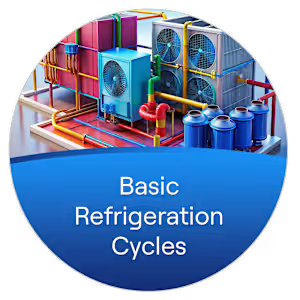
This online training course covers all the various types of refrigeration cycles commonly used in today’s air conditioning systems. The program covers positive displacement, centrifugal, and absorption cycles with details on related compressors and systems. It also discusses principal components of each cycle and how they function. The course includes section tests and a final exam. To receive FAD credit you must pass the final exam.
This online course provides a comprehensive understanding of air conditioning systems including: theory, components, and troubleshooting. Topics covered include: basic concepts and descriptions, operation and basic troubleshooting of the four basic components (evaporator, compressor, condenser, and metering device). In addition, other common system controls and accessories are covered. This program consists of 10 modules that are sold as a complete course.
This online course provides a comprehensive understanding of air conditioning systems including: theory, components, and troubleshooting. This series builds on the concepts covered in General Training Air Conditioning I. Topics covered include: refrigerant characteristics, system dehydration and charging, refrigerant piping and system installation. In addition, part load operation and troubleshooting methods are covered. This program consists of 9 modules that are sold as a complete course.
This online course provides a comprehensive understanding of electrical theory, components, and troubleshooting as it applies in the HVAC industry. Topics covered include basic electrical theory, reading wiring diagrams, electrical meters, motors, electronic devices and electrical troubleshooting. This program consists of 9 modules that are sold as a complete course.
This online course provides a comprehensive understanding of gas heating systems including theory, components and troubleshooting. Topics covered include: combustion theory, gas furnaces, burners, controls, ignition systems, installation practices, ventilation and combustion air, and troubleshooting. This program consists of 10 modules that are sold as a complete course.

This class is for consulting engineers and others performing building load calculations. The class also covers cooling and heating loads for commercial buildings using the legacy version of HAP v5.11 load calculation software.
This 6-hour live training focuses on the process to perform cooling and heating loads and whole building energy analysis for a 2-story commercial building utilizing the new 3D HAP v6 modeling software.
This class is for consulting engineers and others performing building load calculations. The class also covers cooling and heating loads for commercial buildings using HAP load calculation software.
This class is for consulting engineers and other HVAC professionals performing energy modeling using HAP software for LEED® analysis.
This 6-hour live training focuses on advanced modeling techniques using 3D modeling software. This course is designed for existing users of Carrier’s Hourly Analysis Program v6 software who want to take the next step in creating more intricate building configurations and utilizing the most current software features.
This class is for contractors, consulting engineers and other HVAC professionals performing load calculations using Carrier’s Block Load Program.
This class is for contractors, consulting engineers and other HVAC professionals using Carrier’s Engineering Economic Analysis program to perform lifecycle cost analysis.
This course is a great place to start your i-Vu® journey! If you have little or no experience with the Carrier i-Vu system or you’ve never attended a Carrier training course, i-Vu Essentials is for you. In this course, you will work with the i-Vu user interface, create operators and privileges, develop schedules, troubleshoot with alarms and trends, and document using i-Vu’s reporting features. Higher-end topics are also included.
There are many different skill sets in the life of a field technician — engineering, IT infrastructure, technical support, and computer programming, to name a few. Silver training will prepare field technicians to confidently install, commission, troubleshoot, and edit an i-Vu® system.
The Modbus protocol can be found in many industrial controls, from energy metering to variable frequency drives. In this course a student will learn the theory behind the Modbus protocol and how to integrate third-party Modbus devices into an i-Vu® system.
The BACnet® protocol has become the standard protocol within the building automation industry. Students will learn the theory behind the BACnet protocol and how to seamlessly integrate third-party BACnet devices into an i-Vu® system. Students will utilize Snap, Networking, and ViewBuilder skills to read and write BACnet objects while following a sequence of operation to incorporate them into an i-Vu system without stressing the network.
This course is designed for individuals who wish to design complex network systems as well as troubleshoot networks with Wireshark®. Students will set up complex Carrier networks, troubleshoot networks, and create a secure i-Vu® site. They will also focus on troubleshooting an i-Vu system by reading and understanding a Wireshark capture. The dynamic BACnet® binding process is also featured in this course.
There are many different skill sets in the life of a field technician — engineering, IT infrastructure, technical support, and computer programming, to name a few. This Gold training will prepare field technicians and engineers to confidently install, commission, troubleshoot, and edit a control program utilizing Snap.
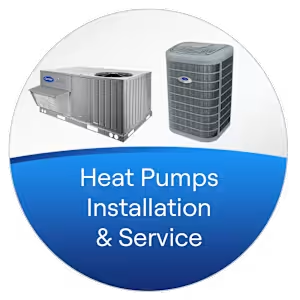
This class is targeted at HVAC technicians who will gain a working knowledge of the operation and troubleshooting of heat pump units.
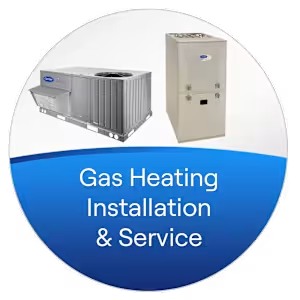
Technicians taking this class will gain a working knowledge of the operation and troubleshooting of residential and light commercial heating systems.
This class was specifically developed for the person with minimum training or field experience. It is intended to quickly help a new hire become a useful and profitable member of the installation team.
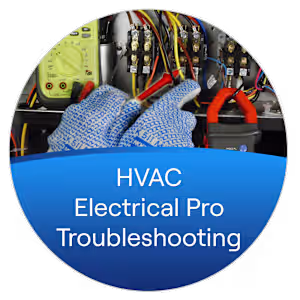
This class is targeted at HVAC technicians, who will learn the fundamental and advanced skills of troubleshooting residential and commercial HVAC electrical systems.
This class is targeted at HVAC technicians, who will learn the fundamental and advanced skills of troubleshooting residential and commercial HVAC mechanical systems.
HVAC technicians will learn how to operate, maintain, and troubleshoot Carrier’s water-cooled centrifugal chillers including 19XL, 19XR and 19XRV.
Technicians taking this class will learn the proper procedures used to maintain and service Carrier 48/50 TC, HC, PG, LC, FC, GC, FE and GE series gas, electric and heat pump type units 25 tons and under.
Technicians taking this class will learn to service Carrier 48/50A, N, P, Z, K, and V series gas & electric type units over 25 tons.
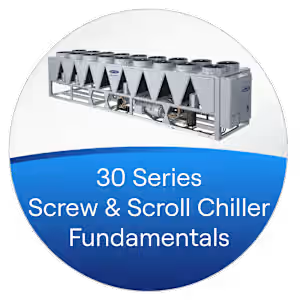
HVAC technicians will learn how operate, maintain, troubleshoot, and service Carrier’s 30 series scroll and screw, air- and water-cooled chillers.
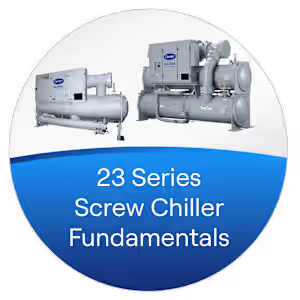
HVAC technicians will learn how to operate, maintain and troubleshoot Carrier’s 23XR/V water-cooled screw chillers.
Get directed to our Business Development team to start the authorization process and discuss sales support.
Get specialized help with system sizing, load
calculation analysis, and technical data required for project design.
Request support for warranty claims,
scheduled maintenance, and genuine spare
parts ordering.
For more information : ahi@ahi-carrier.com